The article, The components of agent memory, explains how Anthropic thinks about memory for AI agents and why effective memory is more than simply storing everything that happens.
Core idea: Agent memory resembles human memory
Anthropic draws an analogy to the human brain:
-
Humans rapidly capture experiences (via the hippocampus), but only some memories become long-term knowledge.
-
During sleep and rest, the brain reorganizes and consolidates memories.
-
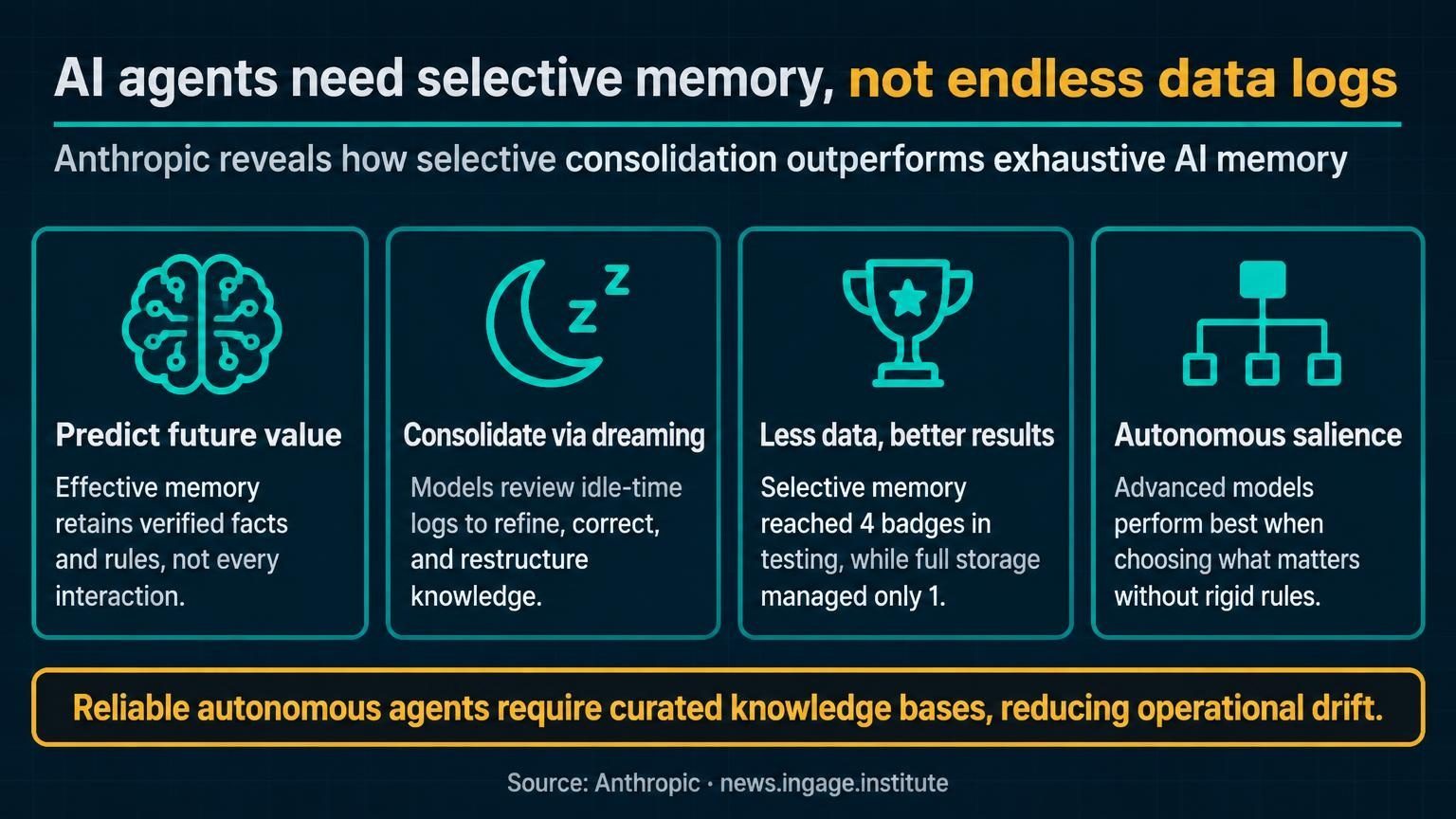
AI agents can do something similar through a process Anthropic calls "dreaming": reviewing logs and past interactions during idle time to refine, reorganize, correct, and strengthen memory.
What agent memory means
The article defines agent memory as:
Knowledge an AI gains from experience and retains across sessions.
This includes information saved for future use, but excludes:
-
model training weights,
-
temporary learning within a single conversation,
-
context-window compression and summarization techniques.
Memory is about predicting future usefulness
A key insight is that memory is fundamentally a prediction about what will matter later.
Instead of recording everything, agents should identify:
-
verified facts,
-
learned rules,
-
recurring patterns,
-
mistakes and their causes,
-
strategies that worked.
Evidence from CL-Bench experiments
Anthropic evaluated several Claude models on a continual-learning benchmark:
-
Less capable models tended to accumulate untested theories or fragmented notes.
-
More advanced models consolidated knowledge into structured documents.
-
Claude Opus 5 and later models created complete feedback loops:
-
recording mistakes,
-
validating explanations,
-
forming reliable rules,
-
documenting evidence for why those rules were correct.
-
The result was significantly improved performance on long-running tasks that required learning across multiple sessions.
Pokémon experiment: Don't remember everything
Anthropic also compared memory use while playing Pokémon Red.
Claude Sonnet 3.7
-
Stored nearly everything.
-
Created hundreds of files and folders.
-
Much of the information became outdated.
-
Spent increasing effort managing memory rather than progressing in the game.
-
Earned only one badge.
Claude Fable 5
-
Stored only high-value information.
-
Focused on plans, strategies, goals, and learned rules.
-
Maintained a small, structured memory system.
-
Reached four badges with far less stored information.
The lesson: selective memory beats exhaustive memory.
Another important finding: Let the model decide salience
Anthropic found that stronger models perform best when given the freedom to determine what is important rather than being forced to follow rigid memory rules.
For example:
-
Telling models to "record only failures" reduced the benefits of memory.
-
Newer models naturally learned when to consult memory and what to save.
-
Older models benefited more from explicit prompts and guidance.
Key takeaway
The article argues that successful AI memory is not about storing more information. It's about judging what is important, consolidating experience into reusable knowledge, and continuously reorganizing memory through reflection ("dreaming"). The most capable agents behave less like databases and more like learners that turn experiences into validated rules and strategies.
Source: anthropic.com